


matsketch answers questions about a large positive-semidefinite matrix, such as a kernel matrix, a genomic relationship matrix or a covariance matrix, while reading only a small part of it. It implements recent randomized algorithms from numerical linear algebra that had no R implementation:
rpchol(): randomly pivoted Cholesky,
which builds a near-optimal low-rank approximation from about \((k + 1)n\) of the matrix’s \(n^2\) entries (Chen, Epperly, Tropp and
Webber, 2025), with the accelerated rejection-sampling variant (Epperly,
Tropp and Webber, 2025).trace_est() and diag_est(): the
XTrace, XNysTrace and XDiag estimators, which recover a
trace or diagonal from a few matrix-vector products (Epperly, Tropp and
Webber, 2024), with Hutch++ and Girard-Hutchinson for comparison.nystrom_precond() and pcg():
randomized Nyström preconditioning for conjugate
gradients (Frangella, Tropp and Udell, 2023).reml_sketch(): all three combined into REML for
genomic variance components that never forms the covariance
matrix, and with grm_matrix() never forms the relationship
matrix either.Each estimator is tested against a brute-force version of its definition.
Install the development version from GitHub:
# install.packages("pak")
pak::pak("mqfarooqi1/matsketch")A Gaussian kernel on 1,500 points in two clusters with a few
outliers. kernel_matrix() stores only the points, and
rpchol() reads the entries it needs:
library(matsketch)
set.seed(1)
X <- rbind(matrix(rnorm(2 * 1300, sd = 0.5), ncol = 2),
           matrix(rnorm(2 * 180, sd = 0.2), ncol = 2) + 4,
           matrix(runif(2 * 20, -6, 10), ncol = 2))
K <- kernel_matrix(X, bandwidth = 0.5)
fit <- rpchol(K, k = 100)
fit
#> <rpchol> rank-100 approximation of a 1500 x 1500 matrix (accelerated)
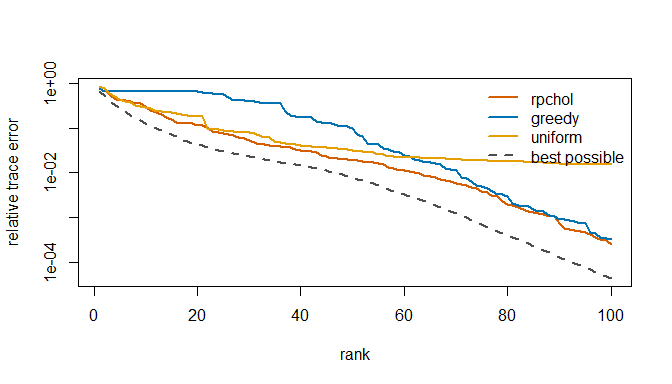
#>   relative trace error : 2.495e-04
#>   entries read         : 152,900 of 2,250,000 (6.80%)
Against the classical rules at the same budget, and the best possible error at each rank:
The trace of a matrix known only through products:
U <- qr.Q(qr(matrix(rnorm(500 * 500), 500)))
A <- U %*% ((1:500)^-2 * t(U))
c(truth = sum(diag(A)),
  xtrace = trace_est(A, m = 60)$estimate,
  hutchinson = trace_est(A, m = 60, method = "hutchinson")$estimate)
#>      truth     xtrace hutchinson
#>   1.642936   1.643178   1.637572
Genomic REML with the relationship matrix never formed:
dat <- sim_genomic(n = 1000, p = 2000, h2 = 0.5, pops = 4)
reml_sketch(dat$y, grm_matrix(dat$M))
#> <reml_sketch> converged in 3 iterations (rpchol rank-100 preconditioner, XTrace with 40 products)
#>          estimate std.error
#> genetic    0.4238    0.0664
#> residual   0.5275    0.0541
#> h2         0.4455    0.0599
#> linear systems solved : 136 (mean 8.6 CG iterations)Chen, Y., Epperly, E. N., Tropp, J. A. and Webber, R. J. (2025). Randomly pivoted Cholesky: practical approximation of a kernel matrix with few entry evaluations. Communications on Pure and Applied Mathematics 78, 995–1041. doi:10.1002/cpa.22234
Epperly, E. N., Tropp, J. A. and Webber, R. J. (2024). XTrace: making the most of every sample in stochastic trace estimation. SIAM Journal on Matrix Analysis and Applications 45, 1–23. doi:10.1137/23m1548323
Epperly, E. N., Tropp, J. A. and Webber, R. J. (2025). Embrace rejection: kernel matrix approximation by accelerated randomly pivoted Cholesky. SIAM Journal on Matrix Analysis and Applications 46, 2527–2557. doi:10.1137/24m1699048
Frangella, Z., Tropp, J. A. and Udell, M. (2023). Randomized Nyström preconditioning. SIAM Journal on Matrix Analysis and Applications 44, 718–752. doi:10.1137/21m1466244
To cite matsketch itself, run citation("matsketch").